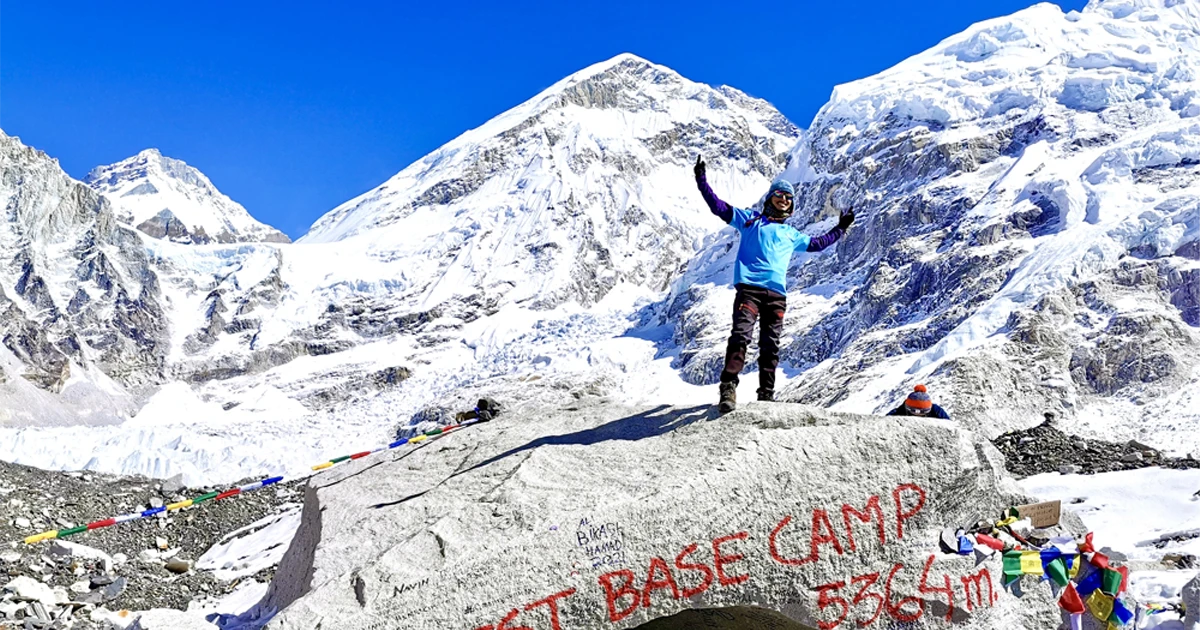
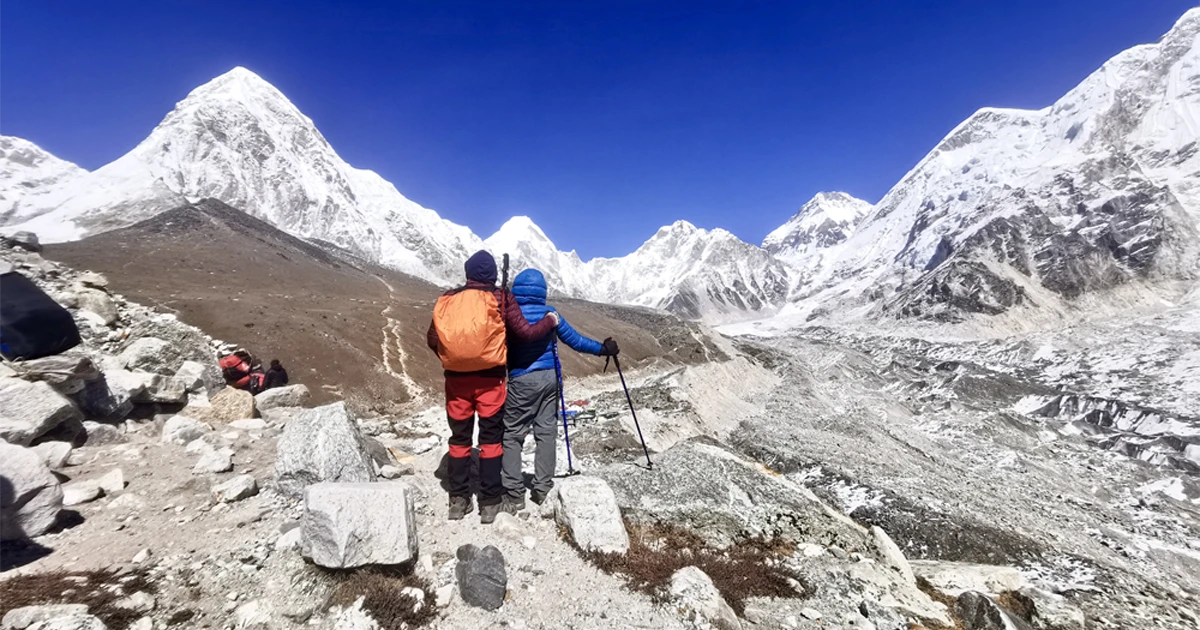
“Can someone like me actually do this?” Some version of that question reaches us every season. It usually comes from someone who has had Everest Base Camp trek on a list for years, half-planned and then postponed. They have watched the documentaries and seen photographs of the prayer flags at 5,364m. What they haven’t seen is an honest account of the two weeks in between.
So this guide is put together differently. Half of it is my own account, taken from a diary I kept on a 2022 trek along this exact route and written on the trail rather than reconstructed afterwards. The rest comes from Bimal, who has guided trekkers through the Khumbu for over fifteen years and started as a porter on these same trails before founding Happyland Treks. I walked it as a client. He has walked it hundreds of times as the person responsible for getting people there and back.
Why Trust This Guide
Most EBC guides online are written by people who have never walked the trail — recycled itineraries dressed up with stock photos. Both contributors here have direct, checkable experience of this route.
Bimal, Happyland Treks’ founder, started on these trails as a porter in 2009–10, carrying other people’s gear before he could speak much English, before he had a licence, and long before he had a company. He learned guiding on the job while portering, and earned his official trekking guide licence at the end of 2010. He guided for other companies for years, including groups of eighteen to twenty people, before registering Happyland Treks in September 2017.
Counting his years as a hired guide and everything since, Bimal has personally led more than 2,600 trekkers. That figure doesn’t include the clients Happyland places with other guides through the company.
I trekked this exact 14-day route with Happyland Treks in 2022, and again independently in 2025, keeping a handwritten diary the whole way — before, during and after. Every first-person passage below comes from that diary rather than reconstructed memory. I’m a travel photographer and videographer by profession and I do at least two treks a year.
Happyland Treks is registered with the Government of Nepal and holds memberships with the Nepal Tourism Board (NTB), the Trekking Agencies Association of Nepal (TAAN), and the Nepal Mountaineering Association (NMA). TAAN is the umbrella body for trekking agencies in Nepal, and only officially registered companies can join, which is why trekkers use it as a legitimacy check. NMA registration is what permits a company to issue peak permits.
Trekkers have left 223+ reviews on TripAdvisor and 126+ on Google, and the company is recommended on TripAdvisor, Google and Lonely Planet.
Who This Trek Suits
Every trekking company says its trek is life-changing. Fewer will tell you who shouldn’t book it. Here’s our attempt.
It probably suits you if
- You’re reasonably fit. Not athletic. Good general shape and some cardio — jogging, hiking, cycling — in the months beforehand is enough.
- You can handle uncertainty. Delayed flights, weather hiding the summit view, symptoms appearing out of nowhere. Nothing about this trek runs exactly to plan.
- You want the whole experience and not only the summit photo. The teahouse evenings, the porter conversations, the slow rhythm of acclimatization.
- You have two full weeks, plus buffer days on each end for Lukla flight delays.
It may not suit you if
- You have a serious heart, lung or cardiovascular condition, or recent surgery. Altitude sickness can hit anyone above 2,500m regardless of age, sex or fitness. Get clear medical clearance first if you have any underlying condition.
- You need a fixed itinerary with zero flexibility. A delayed flight or an early descent will derail a tight schedule.
- You’re only interested in the summit, at any cost. If turning back early — for your health, or as a group decision — would feel like failure rather than a reasonable outcome, sit with that before booking.
- You can’t be offline for stretches. WiFi and charging exist at most teahouses for a fee, but they’re slow, unreliable, and mostly absent above Dingboche.
The disqualifier Bimal sees most often isn’t medical. It’s time.
Bimal has never cancelled a booking over a health condition. But he’s clear about where the real margin lies, and he explains it with a story.
Years ago, guiding on the Poon Hill trail, he took a friend whose own doctor had told him plainly not to go above 2,000m or attempt long walks. The client hadn’t mentioned it. Somewhere above Ulleri, unable to keep climbing, he broke down and admitted it.
“Now that you’re with me, don’t worry.”
Bimal slowed the whole trip to that man’s pace, rested him low, and got him up and back. He’s precise about why it worked, and it wasn’t luck. Poon Hill tops out around 3,210m, where severe altitude sickness is rare. The man had already been in Nepal two months. And — Bimal’s own blunt calculation — he was light enough to be carried down if it came to that.
Then the line that matters here:
You cannot take that risk on Everest Base Camp. Not on Everest, and not on Annapurna Base Camp or Mardi Himal either.
Poon Hill gave him margin to work with. This route doesn’t. If you have a severe heart condition, another critical condition, or recent surgery, don’t book this trek. And whatever your health, speak to your own physician once your trek is planned — about your fitness for altitude, and about whether and how to take Diamox.
The people who actually get hurt on this trail, in his experience, aren’t the unfit ones. They’re the ones trying to compress a twelve-to-fourteen-day trek into seven or eight days by cutting acclimatization.
The Trek at a Glance
| Route | Kathmandu to Lukla to Everest Base Camp to Lukla to Kathmandu |
| Duration | 14 days (including arrival and departure days in Kathmandu) |
| Trip Grade | Moderate |
| Highest Point | Kala Patthar, 5,545m • Everest Base Camp, 5,364m |
| Trekking Distance | ~130km (80 miles) total |
| Daily walking | 4–8 hours |
| Best seasons | Spring (March–May) • Autumn (October–early December) |
| Accommodation | Teahouses throughout |
| Meals | Breakfast, lunch, dinner + cups of tea/coffee daily – included |
| Permits | Sagarmatha National Park + Pasang Lhamu Rural Municipality |
| Price | US$ 1,648 per person, private, solo or in a group |
| Group size | Solo, group or private – the typical group is 2 people |
| Crew | Guide always: 1 Porter per 2 trekkers: assistant guide from 4 up |
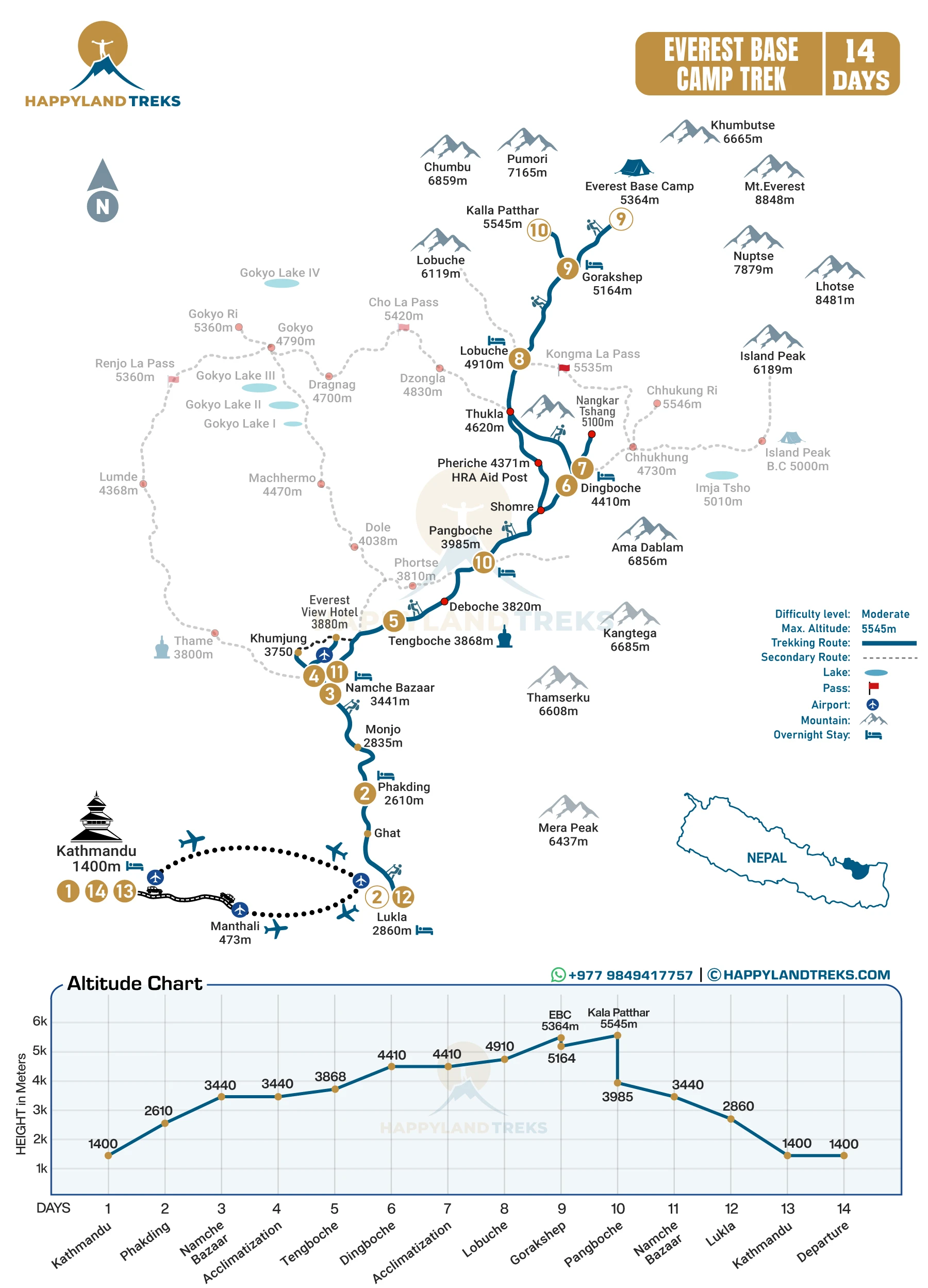
Sleeping Altitude, Night by Night
Trekkers ask us for the maximum altitude of the Everest base camp trek. The number that governs how your body copes is where you spend the night, so here is the full picture.
| Night | You sleep at | Elevation |
| 1 | Arrival to Kathmandu | 1,400m / 4,593ft |
| 2 | Phakding | 2,610m / 8,562ft |
| 3 | Namche Bazaar | 3,440m / 11,286ft |
| 4 | Namche Bazaar (acclimatization) | 3,440m / 11,286ft |
| 5 | Tengboche | 3,868m / 12,690ft |
| 6 | Dingboche | 4,410m / 14,468ft |
| 7 | Dingboche (acclimatization) | 4,410m / 14,468ft |
| 8 | Lobuche | 4,910m / 16,108ft |
| 9 | Gorak Shep — your highest night | 5,164m / 16,942ft |
| 10 | Pangboche | 3,985m / 13,074ft |
| 11 | Namche Bazaar | 3,440m / 11,286ft |
| 12 | Lukla | 2,860m / 9,383ft |
| 13 | Kathmandu | 1,400m / 4,593ft |
| 14 | Departure from Kathmandu |
Your highest sleeping altitude is 5,164m, at Gorak Shep, for one night. Base Camp at 5,364m and Kala Patthar at 5,545m are both day trips you come back down from. That single night is the hardest of the trek, and the itinerary is arranged so you arrive at it already adapted.
If altitude problems appear at Gorak Shep, Pheriche at 4,320m is one walking day below, and Namche at 3,440m is reachable from there. Dropping 800m of sleeping altitude is the most effective thing we can do for you, and we’ll do it without waiting to be asked twice.
What Makes This Trek Special
Ask people why they want to do the Everest Base Camp trek and they’ll say something about the mountain. Ask them again two weeks after they’ve done it and the answer usually changes.
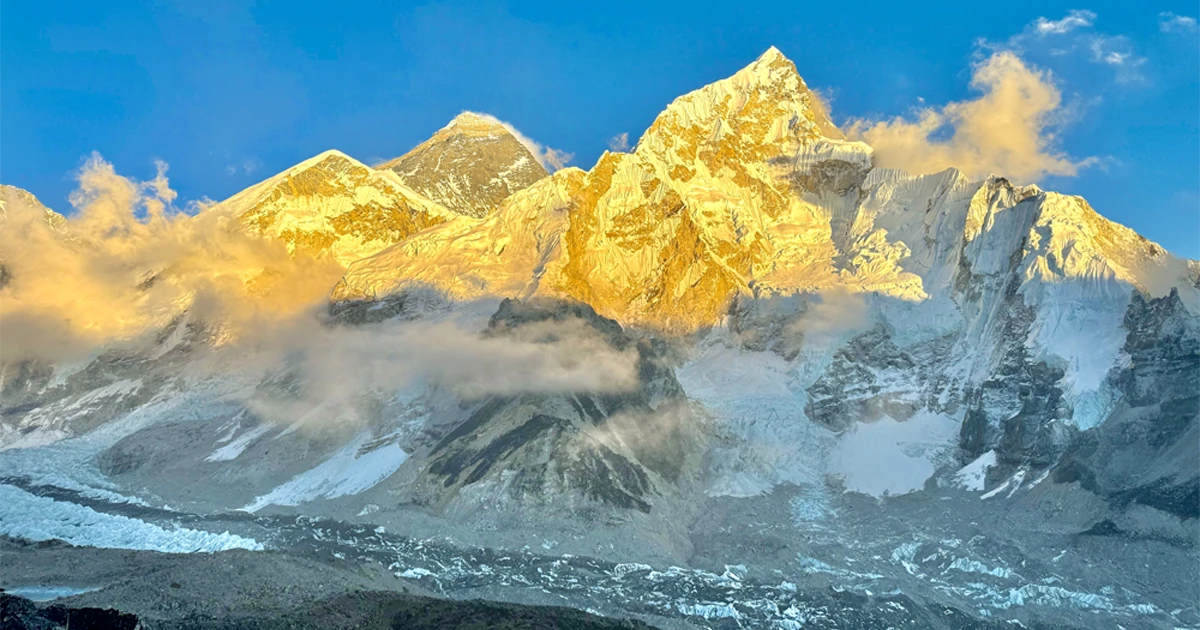
The peaks still matter. Everest, Ama Dablam, Nuptse, Lhotse, Pumori, Kangtega, Taboche, Cholatse, and Thamserku at close range are staggering, and nothing quite braces you for the first sighting. The diary this guide draws from barely dwells on them. What it keeps returning to is smaller: a porter’s smile that communicated more than words could, a card game with strangers who had become a group by the fourth day, a shared bed on the hardest night of the trip because nobody wanted to leave one person alone.
You also walk through Sherpa culture rather than past it. You sleep in these villages, eat what’s cooked in them, and sit in monasteries during evening prayer. The pace does something too. Climb high, sleep low, repeat, for days. Acclimatization forces a slowness that modern life rarely allows, and plenty of trekkers come home talking about that as much as the views.
One thing worth knowing before you book: not every trekker gets a clear sunrise at Kala Patthar. The ones who don’t usually say the trek mattered anyway.
How Hard Is It, Really?
Happyland grades the Everest Base Camp trek Moderate. No ropes, no technical climbing. Don’t let “non-technical” read as “easy.” What makes it demanding:
- Consecutive days of walking: 4–8 hours a day, for nearly two weeks.
- Compressed elevation swings: Days 7–9 take you from 4,410m up to 5,545m and back down to 3,985m inside 74 hours.
- Altitude, independent of fitness, covered in the next section.
- Basic conditions up high: cold rooms, paid hot water, simple food. The mental adjustment is real.
- The energy drop. Around thirty to fourty percent of trekkers arriving in Dingboche notice reduced balance, slower pace and lower energy. That’s most people, and it’s normal.
You don’t need to be an athlete. You need reasonable cardio fitness, and beyond fitness, the patience to walk slowly and consistently instead of pushing hard and crashing.
Your Guide and Your Porter Team
Your guide is licensed
Every Happyland guide holds a trekking guide licence issued by the Government of Nepal and is registered with the Nepal Tourism Board. We don’t ask you to take that on faith.
The sooner you commit, the better your chances of getting both a strong guide and a group to walk with. Also the chances of getting a ticket to Lukla can be slim at peak season if not booked early on.
What your guide carries
- A pulse oximeter. Your guide takes SpO2 readings daily from Dingboche upward. Teahouses often have one too, though you’re never dependent on the lodge having a working device.
- A first-aid kit for blisters, cuts, sprains, painkillers, rehydration salts and basic altitude medication.
- Not your prescriptions. Bring your own regular medication and anything your doctor recommends. You know what works for your body better than we do.
Your porter, and who gets one
- One porter for every two trekkers. A group of two gets one porter, four gets two, six gets three, and so on.
- Solo trekkers travel with a guide only. If you’re walking alone, no porter is included in the standard price. You can add one, and most solo trekkers don’t. We’d rather tell you that upfront than surprise you at Lukla.
- Load capped at 18–20kg, never more. Some operators load 30–40kg for the same pay. We don’t, and the reason is further down this page.
- You carry a daypack of roughly 5–6kg with water, layers, camera, documents and snacks. Everything else goes in the duffel bag we provide, which the porter carries.
- Porters are fully insured, medical and life cover, and their food, accommodation, wages and medicine are all inside your trip cost rather than something they absorb.
- You’ll rarely see your porter mid-day. They move at their own pace and are usually at the teahouse before you arrive.
From four trekkers up, you get a second guide
Book as a group of four or more and an assistant guide is included as standard. It isn’t an upsell or a line item you have to notice and tick.
The reason is operational. With four guests and one guide, a single person falling ill forces an all-or-nothing decision: everybody descends, or the sick trekker goes down with a porter while the guide stays up. With two qualified guides, one descends with the sick trekker and the other continues with everyone else.
Why the price doesn’t drop as your group grows
Most operators quote a lower per-person price for bigger groups. We don’t, and we’d rather explain why than let you assume we’re overcharging.
The crew scales with the group. Two more trekkers means another porter. Four or more means another qualified guide. Extra people don’t dilute the cost of a fixed crew, they add crew. So the price stays at US$1,648 per person whether you come alone, as a pair, or as a party of eight, and the ratio of staff to trekkers at 5,000m is the same as it was at 2,600m.
Everest Base Camp Trek Cost
US$1,648 per person, the same price solo, as a pair, or as a group of eight.
Booking, Payment and Cancellation
Most trekking websites bury this or leave it out. Here it is in full, before you have to ask.
Booking and deposit
- Deposit: 20% of the trip cost, which confirms your dates, booking flight to Lukla, and holds your guide.
- Book early. October and April fill first. During peak season, most guides are booked well in advance. However, a last-minute booking does not mean you’ll be assigned an inexperienced guide. We understand that, for various reasons, some travelers may need to book their trek at the last minute. That’s why we keep experienced guides available specifically for last-minute bookings, ensuring that our clients receive the same level of professionalism, expertise, and support regardless of when they book.
How to pay
- You can also pay in cash using USD, EUR, or AUD. There is no additional charge for cash payments. You can easily withdraw Nepalese Rupees (NPR) from various ATMs, so there’s no need to worry about carrying local currency for shopping or keeping extra cash as a backup.
- Online payment adds 3.7% on top of the total trip cost. That isn’t our margin. It’s what the payment processor charges to move money into Nepal, and we pass it through rather than quietly building it into everyone’s price.
Cancellation: the deposit isn’t refunded, and it isn’t lost either
We’ll be straight about this, because it’s the term people most often find out too late.
If you cancel 28 days before the trek starts, the 20% deposit is not refunded. It becomes credit toward a future trip, and that credit doesn’t expire. Come back next season, in five years, or send a family, or friend in your place.
The reason isn’t a penalty clause. By the time you cancel, that money has already left us. Tickets are already booked for Lukla, and permits are moving, and a guide has turned down other work to hold your dates. The company gains nothing from your cancellation. We’ve simply already spent it on your behalf. Rolling it into a future trip is the only version of this that’s fair to both of us.
If the mountain cancels instead of you
Weather is nobody’s fault and we don’t pretend otherwise. A grounded Lukla flight isn’t a cancellation. It’s why we ask every client to hold two to three buffer days at the end of the trek and keep US$500–1,000 in reserve. If you descend early for health reasons, in case any emergency getting you down safely is never something we argue about first.
Ask us anything about these terms before you pay. We’d rather answer an awkward question in before your trek starts than have it come up at 4,900m.
Why Trek With Happyland Treks
Bimal started as a porter on these same trails, carrying other people’s gear before he spoke much English, learning the route and the language at the same time. Fifteen years later Happyland Treks is registered with the Government of Nepal and holds NTB, TAAN and NMA memberships. And along the way he completed his high school as well. All of it is checkable. Discover why choose Happyland Treks?
In his own words
Asked what he’d say to someone who thinks all trekking agencies are the same, Bimal doesn’t reach for superlatives. He starts by conceding the point:
A lot of it sounds similar on paper. Whether a company charges $1,590, $1,640 or $1,790, everyone works with a profit margin. Nobody runs a business without profit.
Then he draws the line where he thinks it actually falls: how much of what you paid reaches the ground.
1. One hundred percent locally owned, with native local guides. No foreign ownership, no subcontracted middle layer.
2. Every dollar converts into service on the trail. His measure of a good operator is whether the money you handed over shows up around you at 4,500m:
- Generous, unlimited meals on the trail, with the caveat he insists on including: provided food isn’t wasted, out of respect for mountain ethics and local culture.
- Trail nutrition beyond the norm. Happyland Treks provides that fresh fruit after dinner and adds curated dry fruits, nuts and high-altitude energy snacks throughout the trek in the EBC package trek.
- Popcorn over French fries. A small thing that tells you the crew is thinking about what altitude does to digestion.
3. Custom flexibility, budget through luxury. Happyland builds to the price category rather than pretending one product suits everyone. His framing: the service matches the price category, and you get what you pay for.
4. Seasoned local guides and experienced porters as the core of the operation.
How Happyland treats porters
This is the part he gets most direct about.
- Guides and porters are well-paid and fully insured, medical and life cover, not only wages.
- Porter load weight is capped at 18–20kg maximum. Some budget operators load porters with 30–40kg for the same pay.
His reasoning:
Just because a porter physically can carry 30–40kg doesn’t mean we should treat human beings like pack mules. Humanity and dignity come first.
He connects it back to where he started: because the owner of this company began as a porter, Happyland knows exactly what that physical labour costs.
And his own evidence that it lands: these are the practices foreign clients single out in their five-star reviews.