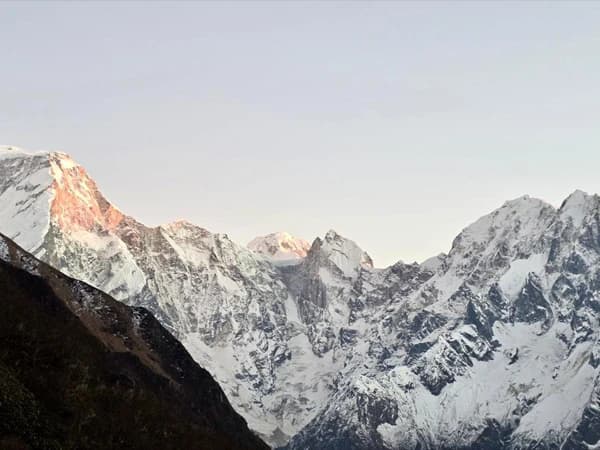
Why is Tengboche Monastery Important on the EBC Trek?
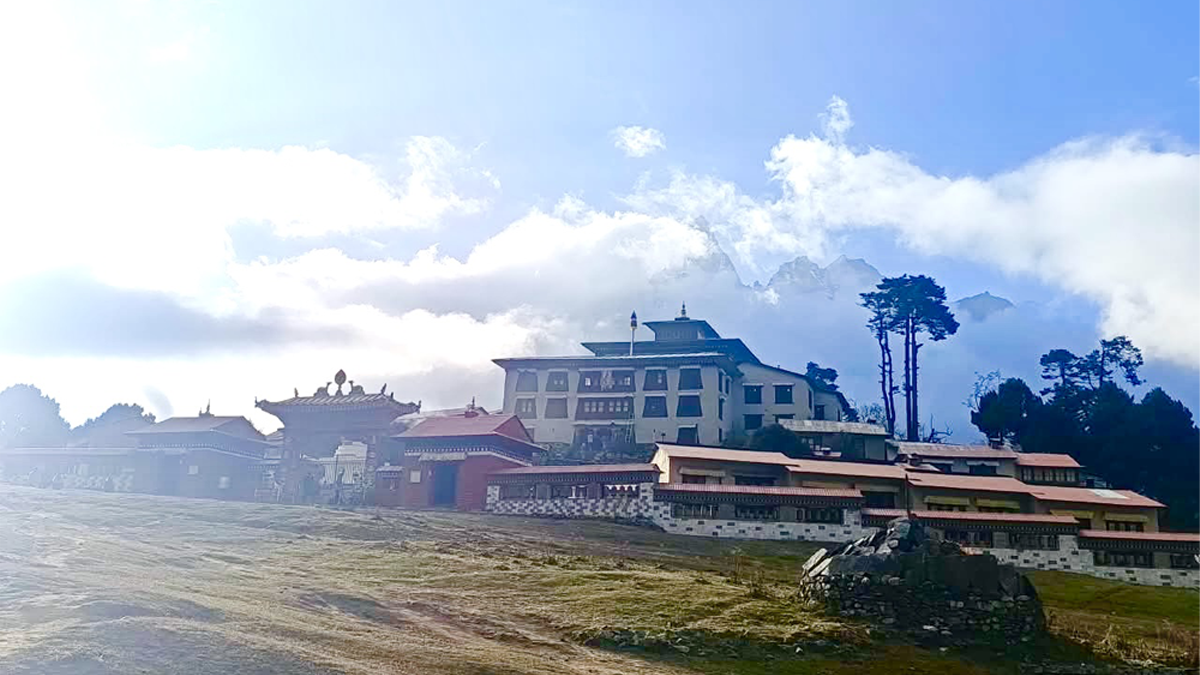
This is why Tengboche Monastery matters: it merges the spiritual, the cultural, and the natural aspects of the Khumbu all in one location. Perched above Tengboche, the monastery is a hub of Tibetan Buddhist practice and Sherpa culture where monks come together for prayers, rituals, and religious ceremonies. It is also intimately linked to Mani Rimdu, the great Buddhist festival that takes place in the Khumbu.
A proper change of pace arrives after days walking through the forest, over suspension bridges, and repeatedly hoisting your legs up to expect them to cooperate. The prayer flags billowing in the mountain air, together with the peace you have been craving and the sound of prayers filling the silence, are enough to make one at peace that is hard to find in such a fast-moving trekking route.
It's one of those locations where you learn about centuries-old Buddhist rituals as you watch mountains that dwarf you in the most impressive way. A guide will explain to you the traditions of the monastery, point out important religious sites, and explain why Tengboche is so meaningful to the Sherpa culture.
''Traveler's Choice — Save $ 52''
Price from
The Story Behind Tengboche Monastery on the Everest Base Camp Trek
Tengboche Monastery has been present in the Khumbu on the Everest base camp trek route for more than a century. It was established in 1916 by Lama Gulu. Since then, it has become an important center of Tibetan Buddhism, Sherpa culture in the Everest region. Tengboche Monastery belongs to the Nyingma tradition of Tibetan Buddhism, and it is related to the Rongbuk Monastery in Tibet.
The old monastery was built for Buddhist practice and meditation to serve the increasing Sherpa population in the Khumbu. Tengboche Monastery has encountered a lot of bad luck. The original monastery was damaged by an earthquake in 1934 and then rebuilt. In 1989, it was again destroyed by a fire that had already damaged many religious objects, scriptures, paintings, other valuable relics. With the support of the surrounding communities, monks, trekkers, and international friends, the monastery was rebuilt.
The Tengboche Monastery that has become familiar to solo or group trekkers alike, is a testament to faith, persistence, and the ancient Sherpa tradition of the Khumbu. It is also a famous place for Mani Rimdu, an important Buddhist festival that includes prayers, rituals, masked dances, and other religious ceremonies. Tengboche has an extremely lively atmosphere during the Mani Rimdu festival as the monks and the local people come together.
The Mountains and Villages you see from Tengboche
You walk into Tengboche, look around, and you see enormous Himalayan peaks in all directions. After all those hours of trekking, the mountains are basically saying hello.
From the view point just outside the monastery, you are treated to panoramic views of some of the peaks of the Everest region in Nepal. Ama Dablam really stands out with its dramatic pyramid-shaped summit rising high above the surrounding alpine peaks. If the weather holds up in the clear day, you can also see Mount Everest, Lhotse, Nuptse, Thamserku, and Kantega around the monastery.
The view is more than just mountains. Tengboche itself sits on a forested ridge with stone-built houses. As you look out over Tengboche village, you can see the curving tumbledown trails, prayer flags, and the rhododendron and pine forests on the steep hillsides. There are trails that connect Tengboche to Deboche and Pangboche and you will see the trekkers making their way along the trail outside the monastery gardens.
From outside the monastery you can watch the peaks rise beyond the valley, the trek to the monastery passing by outside your window. You can see why people keep coming back to the area because of the views.
Early mornings and the late afternoons are great for photographers because the changing light really brings out the contours of the peaks. But even if your photography skills stop at “point phone at mountain and hope for the best,” Tengboche makes the job surprisingly easy.
What is the EBC Trekking Trail to Tengboche Like?
Thegroup EBC trekking trail to Tengboche is one of those sections where the journey is just as rewarding as the destination. Starting from Namche Bazaar, the trail winds through pine, rhododendron, and fir forests, follows the Dudh Koshi Valley, and gradually climbs toward Tengboche. It is not the toughest section of the trek, but there is enough uphill walking to remind your legs that you did, in fact, sign up for a trek.
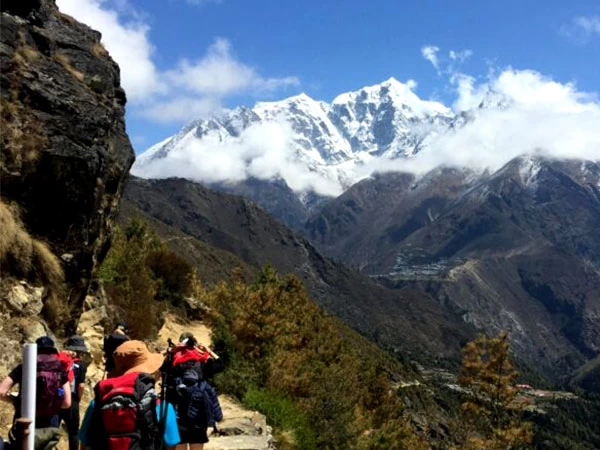
The trail from Namche Bazaar to Tengboche takes about 5 to 6 hours, depending on your pace, trail conditions and rest stops. The route first follows a relatively comfortable path above the valley, with spectacular views of Ama Dablam, Everest, Lhotse, Nuptse, and Thamserku appearing along the way. This is where you will probably stop every few minutes for photos.
From Namche, the trail initially contours along the mountainside with relatively gentle ups and downs. The surrounding forest is quite full of pine, fir, rhododendron and juniper, and in spring, bloomingrhododendrons bring some splashes of colour to the otherwise harsh landscape.
As the trail continues, the mountains start to take over the skylines. You might see your first Ama Dablam scenery, and meanwhile see Mt. Everest and its surrounding peaks from the valleys. The forest, views, and Dudh Koshi's sound are all pretty enjoyable in this part.
The trail eventually drops steeply towards Phunki Tenga, a small settlement along the Dudh Koshi. It’s one of the best spots to have lunch and re-energize before the real climb to Tengboche starts.
The forest keeps the shade all the way down the climb, while opening to amazing views of the surrounding mountains here and there. As you get closer to Tengboche, the trail eventually starts to flat out and the settlement comes into view.
And that’s it. There it is. Tengboche Monastery, perched above the village, with the Himalayan peaks behind.
What does it Feel like to Visit Tengboche Monastery During the Everest Trek?
It is as if you hit pause in the middle of a whirlwind trekking journey. Tengboche Monastery on the Everest base camp trekking trail and it is very peaceful, almost haunting. The wind swaying in the prayer flags, the smell of incense, the brightly colored Buddhist art, the silence of the monastery itself have a very different vibe from the rugged path that you just trekked.
Inside, you may see Buddhist paintings, statues, and prayer wheels, and also some other Buddhist religious characteristics. You may also see some monks in some prayers or ceremonies, depending on when you visit.
The experience also relates a lot to the Sherpa culture of the Khumbu. Tengboche is a major Tibetan Buddhist monastery for the people in the area; the visit also lets you see a side of the Khumbu that has been witnessed by people who have inhabited Everest for many years.
Then, you take a step back, and the Himalayas take the spotlight again. AmaDablam towers upright over the landscape; Everest, Lhotse, Nuptse, Thamserku, and other peaks are in the background.
There’s also an emotional feel to visiting Tengboche at this part of the trek. You have trekked through the lower Khumbu, arrived in the market towns of Namche Bazaar, climbed higher into the mountains, and now you find yourself standing at the most notable cultural site in the region.
A Few Simple Monastery Etiquette Tips
Tengboche Monastery is a site of worship, so keep it quick and respectful.
- Dress in modest clothing when visiting the monastery. Trekking clothes are acceptable, but not too revealing.
- Take part in this place of prayer and meditation by keeping the conversation level down and jokes to a minimum inside the monastery.
- It may be hard or impossible to take pictures in some places or during certain religious ceremonies. Ask your guide about the restrictions prior to taking pictures of any sort.
- If the monks are performing a prayer or ritual, quietly take a seat and observe from a proper distance and refrain from unsociable behavior.
- Learn how to properly pass a stupa, mani wall, prayer wheel, and other sacred structures.
- Hire a local Sherpa guide to explain the suitable places to visit, what can be photographed, and customs to observe. This makes it much easier, particularly if the place is a first visit.
When is the Best Time to Visit Tengboche Monastery in the Everest Region?
According to the averages, you can book your private trek to Tengboche Monastery during spring (March, April, May) or autumn (End of September, October, November). In general, during these months, the Everestregion provides stable trekking conditions, clear mountain views, and warm daytime weather. In other words, you will have your best chances if you want Tengboche without the weather yelling at you. Trekking to Tengboche monastery people also call Everest view trek.
During these times, you will have clearer skies, better views of Ama Dablam and other surrounding Himalayan peaks, and overall more comfortable conditions for trekking to Tengboche village and exploring the monastery. Trails are also more bustling because trekkers flow in from almost every country heading to Everest Base Camp. So yes, you will experience trekkers all over, but you will also experience that classic atmosphere.
And if you want to experience ManiRimdu, spend some days in autumn, and you will get to participate in the major Buddhist festival at Tengboche, which gets the whole Sherpa Buddhist tradition (prayers, rituals, masked dances, celebrations, and so on).
But for winter and monsoon, well, you can still go, but it is more unpredictable. Winter can be cold and snowy, while monsoon can bring rain, clouds, and slippery trails. So, if you want to be outside the monastery holding your face to the giant Himalayan peaks in the sunset, bet on spring or autumn.
Visiting During the Mani Rimdu Festival
If your schedule lines up with Mani Rimdu, a visit to Tengboche Monastery during your trek to Everest Base Camp can be hit or miss, but most likely a heck of a lot of fun. ManiRimdu is one of the most significant Buddhist festivals celebrated by the local Sherpa community during their gatherings at Tengboche Monastery in Khumbe Everest.
It is an annual festival during which the monastery and its area undergoes a transformation. Monks conduct prayers and dances, which encode Buddhist teachings, in hopes of bringing peace and prosperity to the area. It’s a huge boost to the local community’s spiritual energy.
If you are lucky enough to cross paths with Mani Rimdu, you are in for an immersive cultural journey and a great opportunity to interact with local monks who are keen on raising their spirits. In addition to what’s normally seen in photos of Tengboche Monastery, this is also a quiet opportunity to see Buddhist celebrations true to form.
A word to the wise: if you happen to be there the right day, respect the neighboring monks, keep your voice down, ask permission before you photograph them, and offer your utmost support in their daily and spiritual routines.
Because Mani Rimdu becomes an annual event at a different time of the year, check the official Mani Rimdu schedule for your year before planning your itinerary.
Why Visit Tengboche on a Guided Everest Base Camp Trek?
Popular route Tengboche Monastery on the Everest base camp trek many trekkers chance to visit the Tengboche monastery which is a few minutes walk from your trekking tea house. And Tengboche is one of those stops on the Everest Base Camp Trek in Nepal that you shouldn’t just snap a photo to scroll through later and then get on your way with a snack. It’s an excellent stop for a quiet pause to enjoy the spirituality of the trek, the village’s rich Sherpa Buddhist culture, or the unforgettable Himalayan scenery that fills the surrounding area.
The monastery presents a good opportunity to rest a day and observe the spirituality of your journey firsthand. Wander around and experience the traditional Buddhist environment, Sherpa culture, and, if you are lucky, the extravaganza that is the Mani Rimdu festival. And if you step outside, the scenery will take over quickly. AmaDablam, Everest, Lhotse, Nuptse, and Thamserku are all going to be on the horizon.
And when you join a guided Everest Base Camp Trek, you will have the chance to see all of this with someone who can walk along and explain the history of the monastery, local traditions, mountain names, and customs. Rather than merely see a monastery and a bunch of enormous mountains, you will be able to understand why this stop matters.
So is Tengboche worth adding to a stop on the EBC Trek in Nepal? Absolutely. It’s where the trail, spirituality, Sherpa culture, and Himalayan scenery come together.
FAQs
How high is Tengboche Monastery?
Tengboche Monastery sits at 3,868 meters / 12,690 feet above sea level. So yes, you are already pretty high up when you arrive!
Where is Tengboche Monastery located?
It is in Tengboche village in Nepal's Khumbu region, inside Sagarmatha National Park, along the classic Everest Base Camp trekking route.
How long does it take to trek from Namche to Tengboche on the EBC trail?
The trek from Namche Bazaar to Tengboche usually takes around 5 to 6 hours, depending on your pace, stops, and trail conditions.
What is Tengboche Monastery famous for?
It is famous for its Tibetan Buddhist heritage, Sherpa culture, Mani Rimdu festival, and spectacular views of Ama Dablam and other Himalayan peaks. Including Mount Everest.
Can you visit Tengboche Monastery on the EBC Trek?
Yes! Tengboche Monastery sits directly on the classic EBC route, so you can visit it without taking a major detour. Just follow local rules when entering.
When is the Mani Rimdu festival held at Tengboche?
Mani Rimdu is generally celebrated during the autumn trekking season, but its exact dates change each year because they follow the Tibetan lunar calendar. Check the dates before planning your trek around it.
What mountains can you see from Tengboche Monastery?
You can enjoy views of Ama Dablam, Mount Everest, Lhotse, Nuptse, Thamserku, and Kantega, depending on weather and visibility.
How long do you usually stay in Tengboche?
You stay overnight in Tengboche, giving you time to visit the monastery, enjoy the mountain views, and rest before continuing toward Dingboche for Everest base camp.
Is Tengboche Monastery open to visitors?
Yes, visitors can generally enter the Tengboche monastery, although access may vary during prayers, ceremonies, or religious events. Follow your guide's advice and respect any restricted areas.
Does the Everest View Trek go to Tengboche or Namche Bazaar?
On the Everest view trek some of the trekkers stop in Namche Bazaar and do sight tours like explore around, and hike to Everest view hotel. And some trekkers continue to trek to the Tengboche Monastery.
How Many Days from Kathmandu to Tengboche Monastery?
Kathmandu to Tengboche Everest view trek about 6-7 days.