Forgot To Buy Trekking Insurance Before Nepal? Can You Actually Get Insured After Arriving in Nepal?
Yes, you can still sort out trekking insurance after arriving in Nepal, as long as your trek hasn’t officially started yet. And in Kathmandu, especially around areas like Thamel, it’s actually a pretty common part of the pre-trek routine.
Here is how it usually works in real life. You don’t walk into an “insurance office” and deal with everything directly. Instead, you go through a simple setup involving trekking agencies, travel agencies, or insurance representatives who handle the paperwork for you. The policy is often issued on the same day or next day.
However, there is a catch that most people don’t realize. Not every situation is covered the same way. Some policies require clear mention of high-altitude trekking, helicopter evacuation coverage, and specific altitude limits depending on your route. That’s why trekking agencies in Kathmandu often guide you based on where you are actually going because the requirements for the Everest Base Camp Trek are very different from something like the Ghorepani Poon Hill Trek.
Is Travel Insurance Mandatory in Nepal?
Travel insurance matters a lot in Nepal when treks or climbs are on the list. Getting into the country as a visitor does not require proof of coverage at border checkpoints. Yet stepping outside urban areas often means facing trail sections where having protection becomes essential. Without it, moving forward gets complicated fast.
Most guided treks demand proof of coverage before setting foot on trails like the Annapurna Circuit or Manaslu route. Though it might seem optional, operators refuse entry without a policy covering high elevations and sudden medical transport. Starting your hike? Expect strict checks for documentation that protects against mountain risks.
This happens mostly since walking through Nepal’s mountains brings serious dangers, like getting sick from thin air, far-off trails with no help nearby, or needing a helicopter when roads vanish. Coverage means urgent evacuations and hospital care won’t stall.
Even though Nepal won’t stop you from crossing the border without insurance, the local trekking rules quietly require it. Without valid coverage, agencies refuse to process your permits, shutting down plans before they start.
Where Can You Get Trekking Insurance in Kathmandu? The Different Ways You Can Get Covered
If you are in Kathmandu and still need trekking insurance, you have actually got a few simple options, and none of them are complicated or hard to access.
The most common way is through trekking agencies and travel agencies in areas like Thamel. These agencies usually work with insurance partners and can arrange coverage for you based on your trekking plan. You just share your passport details, trek itinerary, and travel dates, and they help set up a policy that matches your route.
Another way is through insurance representatives in Kathmandu who directly issue travel and trekking insurance policies. These are often quick, same-day arrangements and are commonly used by last-minute trekkers who have already arrived in Nepal without coverage.
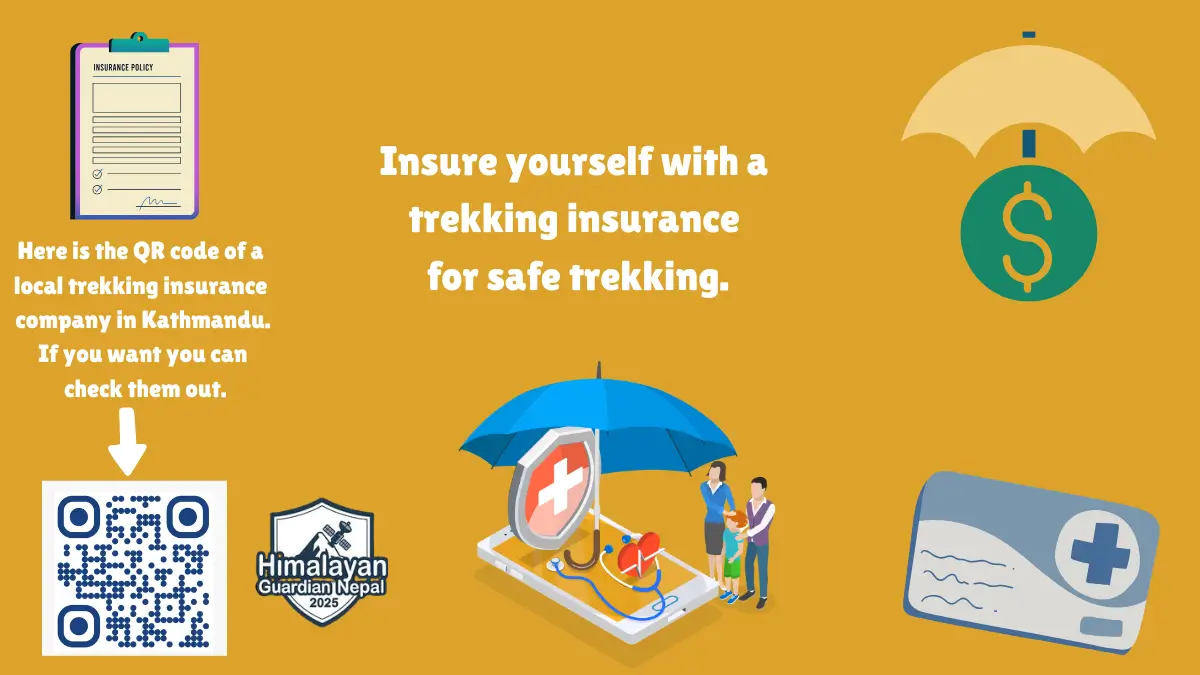
Now, if you are wondering what this looks like in practice, somelocal providers such as Himalayan Guardian offer trekking insurance plans that can be arranged for trips ranging from a week to around two months.
The price usually depends on three things: your age, how long you are trekking, and how high you plan to go. They also offer optional satellite safety devices if you are heading into remote regions were getting lost would make for a very bad travel story.
For more popular routes like Annapurna Base Camp Trek, Mardi Himal Trek, Ghorepani Poon Hill Trek, Langtang Gosaikunda Lake Trek, Everest view Trek, or Langtang Valley, you can simply choose the standard insurance option without the extra tracking device.
Hold Up, How Does the Whole Process Actually Work?
The process of getting trekking insurance in Nepal is actually much simpler than most people expect.
Here is how it usually goes in real life. First, you choose where you are arranging it from. You share your valid passport, trekking itinerary or route details, your travel dates, and basic personal contact information.
Once that’s done, the agency matches you with a suitable insurance policy based on your trek type and altitude. This part matters because trekking insurance in Nepal isn’t one-size-fits-all. A high-altitude trek like the Manaslu Circuit Trek, Everest Three High Pass Trek, or the Everest Base Camp Trek needs very different coverage compared to shorter routes like the Ghorepani Poon Hill Trek.
After selecting the plan, payment is made, and the policy is usually issued digitally, often within a few hours or the same day. You will receive the insurance document via email or a printed copy, which you can carry for permits or agency verification.
Can You Buy Insurance Mid-Trek If You Realize Something Is Missing?
No, you generally cannot buy trekking insurance once your trek has already started in the mountains.
Trekking insurance in Nepal is designed to be arranged before you begin your actual journey on the trail. Once you leave Kathmandu and start routes, most insurance providers will not issue or activate new coverage mid-way.
Now here’s the situation many trekkers don’t think about until it’s too late: what if you suddenly realize mid-trek that your insurance doesn’t include high-altitude coverage?
In that case, unfortunately, you cannot upgrade or fix the policy while you are already on the trail. If your insurance does not cover the altitude you are currently at, any medical emergency or helicopter evacuation request can be rejected by the provider. That means you may have to pay for treatment or rescue costs on your own, which in Nepal can become extremely expensive, especially in remote areas.
This is exactly why trekking agencies in Kathmandu stress insurance checks before the trek begins.
Why Are More Trekkers Choosing to Arrange Travel and Trekking Insurance Provider in Kathmandu Instead?
More trekkers are now choosing to arrange their trekking insurance in Kathmandu because it simply fits the reality of how Nepal trips actually happen.
A lot of travelers arrive in Nepal with a rough idea of their trek, but things often shift after reaching Kathmandu. Someone planning the Everest Base Camp Trek might switch to the Annapurna Circuit Trek or decide on the Langtang Valley Trek instead, based on time, weather, or fitness. Sorting insurance locally makes it easier to match coverage with the final route instead of guessing everything before flying in.
There is also the practical advantage of local guidance. Trekking agencies in Nepal understand altitude requirements, helicopter evacuation needs, and region-specific risks better than generic travel policies made for city tourism. So when you are heading toward high-altitude routes, the insurance gets aligned with actual on-ground conditions.
Why Standard Travel Insurance Usually Isn't Enough for Trekking in Nepal
Most travel insurance covers regular trips, think weekend getaways, quick tours, or flying abroad. Problems it handles often include held-up flights, missing bags, or small health troubles. Yet walking through Nepal’s mountains isn’t that kind of journey at all.
Footsteps on paths like the Annapurna Circuit lead into thin air, far from towns or hospitals. With no roads nearby, help can be hours away when breathing gets hard. Missed flights matter less than lungs struggling at height. A bad headache might turn serious fast, needing urgent airlifts out. Mountains don’t care about plans.
This is where standard travel insurance falls short. Many basic policies either exclude trekking activities altogether or place strict altitude limits that don’t match Nepal’s real trekking routes. So even if you are technically “insured,” your coverage may not apply when you actually need it most.
Trekking insurance in Nepal is built specifically for these situations. It includes high-altitude coverage, emergency medical support, and evacuation from remote mountain regions, all the things standard policies usually don’t prioritize.
Why Helicopter Rescue Coverage Matters More Than Most Trekkers Think?
Most people hiking through mountains pay little mind to helicopter rescue, until they are stuck on a ridge with a broken ankle. That moment changes everything about how they see their policy. When altitude sickness hits hard or weather traps your mid-slope, that clause stops being fine print. It turns into the only thing between safety and real danger.
Out in Nepal, along trails such as the Manaslu trek, vast stretches lie beyond road access, far from clinics. When high-altitude illness strikes, or an accident happens, maybe even something worse, rescue often comes from above.
Here is something real you might not expect: getting flown out by helicopter in the Himalayas can drain thousands fast. No insurance means paying every dollar yourself.
Because of this, skipping helicopter evacuation means risking everything on a Nepali trail. What looks like an add-on actually holds your whole trip together when things go wrong high up where help can’t hike in. It ensures that if something goes wrong at high altitude, help can actually reach you quickly without financial or logistical barriers slowing things down.
Before You Buy with a Travel and Trekking Insurance Provider in Nepal, Check These Things First
Altitude Coverage Limits for Different Nepal Treks
When you are choosing insurance through a travel and trekking insurance provider in Nepal, altitude coverage is one of those details you absolutely cannot ignore.
Some trails in Nepal climb much higher than others, yet insurers usually cap how high they will cover. Go above their line, then protection might vanish completely.
Most of the time, out on actual trails, things look like this:
Most insurance plans cover short hikes such as the Ghorepani Poon Hill Trek because they rarely rise past 3,500 meters. Though brief, these trails are seen as standard due to their modest elevation.
Most folks tackling trails like Mardi Himal or Annapurna Base Camp face heights between 4,000 and 4,500 meters. With climbs this steep, coverage needs to cover altitude-related risks, basic plans won’t cut it.
Up top, past 5,000 meters, lies the old-school Annapurna trail. Heading there means getting a policy that covers extreme elevation. Rescue by air must be clearly listed.
Out in the wilder trails, routes such as Manaslu or Kanchenjunga, the rules tighten up. These paths stretch on much longer, climb far higher, yet offer almost no chance of quick help if things go wrong.
What Does the Best Insurance Coverage Actually Look Like?
Deep in the Himalayas, what matters most is if your trekking insurance responds when needed, not its name or origin. A label means nothing if help never arrives.
Most plans fail when heights rise beyond thought. Should your path climb past 4,000 meters, the insurer’s okay needs to stretch just as far. Without written consent for peaks near 5,000 meters, protection vanishes fast.
Here comes the part about medical help when things go wrong. Walking through Nepal means more than sore muscles, think quick-onset altitude problems, falls, or illness far from clinics. When care is needed fast, solid coverage steps in so delays don’t happen. What matters shows up when roads end and help must arrive.
After that, a helicopter might be needed, this step matters more than most realize. When trouble strikes on remote trails, flying out could be the sole option available. A strong policy should clearly include this without hidden conditions or vague wording.
The best coverage also understands trekking as an activity, not just “travel.” That means trekking, hiking, and high-altitude adventure sports are explicitly included, not accidentally excluded in fine print.
How Much Does Trekking and Travel Insurance Usually Cost in Nepal?
The cost of trekking and travel insurance through a provider in Nepal usually depends on one simple thing; how “serious” your trek gets in terms of altitude, duration, and risk.
For the real-world range: a solid trekking insurance policy that includes up to 6,000 meters altitude coverage and full helicopter evacuation typically costs between USD 80 and 160 for most standard trek durations. This is the range most trekkers end up choosing when they want proper coverage without taking unnecessary risks.
The final price can shift depending on a few things, such as your age, how high your trek goes, the evacuation limit in the policy, whether trip cancellation is included, and optional add-ons like gear protection or flight delay coverage. The main thing you have to do is to make sure and clear what is covered in your insurance cost.
FAQs
Can I buy trekking insurance after arriving in Nepal?
Yes, you can buy trekking insurance in Kathmandu after you arrive in Nepal or you can buy online as well. as long as you haven’t already begun the journey.
Do I need insurance for the Everest Base Camp Trek?
Yes, it’s a must. Most agencies won’t allow you to start the Everest Base Camp Trek without proper high-altitude insurance and helicopter evacuation coverage.
Can trekking agencies arrange insurance for me?
Yes, most trekking agencies in Kathmandu can arrange it quickly for you based on your route, altitude, and travel dates.
What should my trekking insurance include?
You need coverage that matches your highest trekking altitude, usually up to 5,00 to 6,000 meters, with emergency helicopter evacuation included.
What happens if I start trekking without insurance?
You risk being denied by trekking agencies, and in case of emergency, you may have to pay full rescue and medical costs yourself.
Is travel insurance from my home country enough for the Nepal trekking?
Sometimes yes, but only if it clearly includes high-altitude trekking and helicopter evacuation, otherwise it may not be valid in real situations.
How long does it take to get trekking insurance in Kathmandu?
Usually very fast. Most policies are issued in one day, sometimes within a few hours, through agencies.
Can I upgrade my insurance once I start the trek?
No, once the trek has started, you generally cannot upgrade or change your insurance coverage mid-way.
Does trekking insurance cover the helicopter rescue in Nepal?
Only if explicitly included, always check for helicopter evacuation coverage up to your trek’s altitude. It depends which policy you take.
Is cheap trekking insurance worth it for Nepal treks?
Not really, cheap policies often miss altitude or rescue coverage, which are the most important parts in Nepal.
What documents do I need to get travel and trekking insurance in Kathmandu?
Usually, just your passport, trek route, travel dates, and basic contact details are enough. Including trekking agency name.
Can solo trekkers get insurance easily in Nepal?
Yes, solo trekkers can easily get insurance in Kathmandu through agencies or online-linked providers before starting the trek.
Do I really need to buy Local Nepal trekking insurance for Nepal trekking?
You can buy your Nepal trekking insurance either Nepal or any other country.
For Nepal trekking can I purchase my insurance from my home country?
Yes absolutely you can buy Nepal trekking insurance from your home country or any other place you like.
Is it easy to buy trekking insurance in Nepal?
Yes it is very easy to buy trekking insurance in Nepal.
What document shall I need to provide for my Nepal trekking insurance?
The document you have to provide is your valid passport, trekking itinerary route, start and end date, with elevation the maximum altitude of the trek.
Can I buy my Nepal trekking insurance by online payment in Kathmandu or have to attend physically in the office?
You can buy Nepal trekking insurance by online Payment link via bank transfer Debit and Credit card, or if you want to visit them physically that’s also possible.